


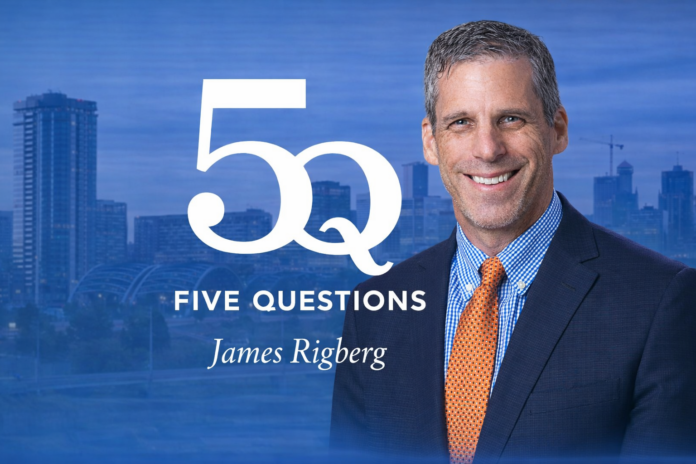
This week’s 5Q features James Rigberg, a member of the Commercial Litigation Practice at Dickinson Wright in Denver.
Rigberg represents investors, developers and business owners in high-stakes disputes involving ownership, control and recovery of valuable assets.
Question 1: If you could master a musical instrument that you don’t already know how to play, which one would you choose, and why?
Rigberg: I’m still working toward mastering the guitar — a goal I hope to achieve sooner rather than later. Piano is next on the list to give me an additional songwriting platform but also largely because I’ve always wanted to be good enough to justify buying a Mellotron. There’s something about that sound — imperfect, haunting and unmistakably vintage — that I’d love to be able to play myself.
Q2: What’s your favorite clause of the Constitution, and why?
Rigberg: Free speech is the foundational right that safeguards all others. A government overreach, such as establishing a religion, would be deeply troubling but so long as people retain the freedom to speak, they also retain the power to challenge that overreach and restore constitutional balance. Without free speech, however, that corrective mechanism disappears. It is the right that enables us to defend or, if necessary, reclaim every other right.
Q3: If you could travel back in time and talk to a historical figure about the law, who would you talk to, and what would you say to them?
Rigberg: Voltaire. To make the most of the conversation, I’d open with a question that feels as relevant today as it would have in his time: If a society is committed to tolerating all viewpoints, how should it respond to movements that use that very tolerance to dismantle it? I suspect the exchange would be equal parts spirited and entertaining but also genuinely illuminating — exactly the kind of conversation that might push toward a better answer than either of us could reach alone.
Q4: Which rule of evidence do you hate the most and why?
Rigberg: I don’t have much patience for how loosely courts sometimes apply the standards for expert testimony. In theory, I’m a strong supporter of the limits on qualifying experts. In practice, though, courts often skip a more fundamental question — whether the field itself rests on a sound, testable foundation. If I had to pick something I hate, it’s the willingness to treat familiarity as a substitute for rigor when it comes to expert evidence.
Q5: What’s your favorite movie or TV show?
Rigberg: This has been a toss-up between “The Shawshank Redemption” and “L.A. Confidential” since the latter came out in 1997. Great, well-executed stories.
Read more about Rigberg.
Law Week Colorado invites Colorado lawyers, paralegals, judges, law professors and other legal professionals to share their insights and experiences with the community with our weekly 5Q Questionnaire.
Responses may be edited for clarity and length and will be published in the order received. Your patience is appreciated. If you have questions, email [email protected].