


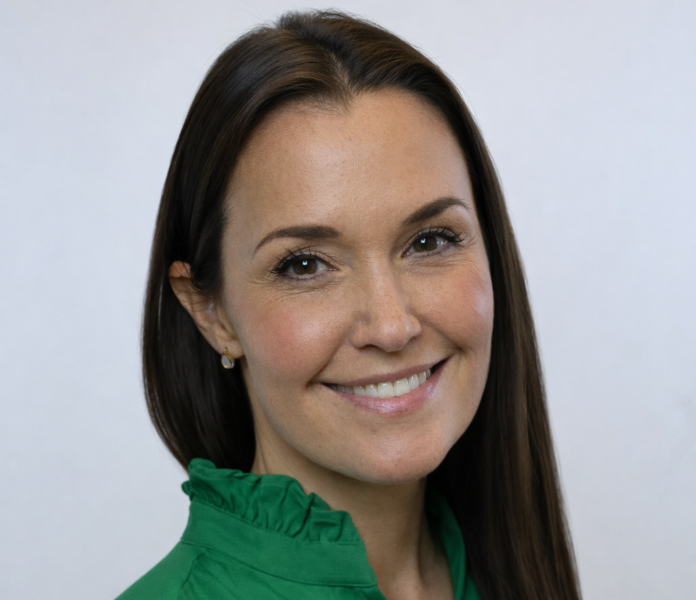
When Elisa Overall received an email announcing the 2026 Alli Gerkman Legal Visionary Award from the Institute for the Advancement of the American Legal System at the University of Denver, she clicked through eagerly. “I was excited to see who won because I have always been so inspired by the people who have done these things,” she said. Then she saw her name. Stunned, she thought, “I’ve got to go do something inspiring now.”
Upon reflection, Overall, who goes by Emo, is grateful her justice work is making a difference.
As the first executive director of the Colorado Access to Justice Commission, she supports the organization’s 32 commissioners and six committees in implementing a statewide strategic plan to expand access, quality and fairness in the justice system.
“I am trying to create as much continuity as possible between the people making policies and the people experiencing the effects of those policies,” she said.
In 2023, she guided the justice commission through its transition to a codified commission of the state of Colorado, where it serves as a policy-advising body to the General Assembly. Since then, the commission has expanded its programs and is positioned to administer millions of dollars annually for legal aid organizations through Colorado’s Equal Justice Fund.
“Emo is a rare combination of visionary and doer,” said Brittany Kauffman, IAALS CEO. “The systems she has helped build don’t just matter for Colorado; they offer a roadmap for how jurisdictions across the country can strengthen access to justice in meaningful, lasting ways.”
Overall’s commitment to justice is grounded in her lived experience. She grew up in Tucson in a Mexican-American family. “I was immersed in the social justice aspect of living in a place that used to be part of Mexico and also has a mixed view of Mexican immigrants,” she said.
Later, after she received her undergraduate degree in biology and moved to Telluride “looking for adventure,” she became “known as that lady who speaks Spanish and will help you out.”
She said, “I was working at a nonprofit whose sole purpose was to support the immigrant communities. I saw the many ways that an absence of an understanding of the law was exploited by employers and landlords, and that was infuriating.”
The tipping point for Overall came after a landlord directed his maintenance crew to paint over mold in an affordable housing unit. After months of petitions and residents suffering asthma symptoms, the building was condemned. Tenants slept in their cars, and the landlord refused to return security deposits.
Overall recalled, “I am an advocate, a feisty Latina, and I’m making calls and about to jump in my car and drive to California,” where the landlord’s company was based. Instead, a lawyer friend suggested he take the case pro bono.
“I didn’t even know what that meant,” Overall said with a laugh. “But he had an associate write about a paragraph citing the law, and immediately, the security deposits were returned.”
After discovering what a legal intervention could do, Overall was “done with the whack-a-mole of trying to improve one injustice after another.” She enrolled at the University of Denver Sturm College of Law “to see if I couldn’t help create policies that would make our world a little more just.”
Today, much of Overall’s work involves creating alliances and policies across the legal aid community and human services. Often, “the same people rejected for food stamps are also needing rental assistance,” she said. “Those groups can come together and realize that, maybe, the applicant is not filling out the application properly.”
Likewise, she aims to build trust between legal professionals and the judicial system. “We want to even the playing field,” she said. Earlier this year, Overall presented to the Colorado Joint Judiciary Committee the commission’s study about the barriers people face when navigating civil legal issues.
To help people where they need it most, the commission offers legal aid clinics in Colorado libraries. The clinics serve about 100 patrons a month, and the waitlist is growing. “This is where the rubber meets the road,” Overall said. “For some, they have simply had no reliable place to get information and guidance, and they’re asking, ‘How can you make me go to court, and there’s no one to tell me how?’”
Overall is constantly seeking to increase access to legal information. “This is not a threat to attorney fees,” she said. “We are talking about developing tools for the most marginalized, (for) people who can’t afford an attorney.”
She added, “After all, ask any attorney, and they say they love access to justice. We are asking attorneys to join us in this work.”
The Alli Gerkman Legal Visionary Award will be presented to Overall at IAALS’ 18th annual Rebuilding Justice Award Dinner on April 23.