


The results are in from the annual Law Week Colorado survey of Colorado firms, renamed Colorado Practice Insights, offering a numeric snapshot of the state’s legal landscape. Attorneys described navigating increasingly intricate policies and varied economic conditions, all while maintaining a firm focus on client value.
The takeaways are broad. Survey respondents reported that litigation remained strong in 2025, with growing complexity across multiple practice areas. After a stop-and-start market, banking and financial services steadied as clients adapted to shifting conditions.
In Denver, family law practices highlighted heightened tensions, driven in part by economic pressures and immigration concerns. Across the state, clients consistently sought highly responsive service at a fair value, and most firms said they met the majority of their annual strategic and financial goals.
Trends by the Numbers
This year’s survey respondents included a mix of local boutiques, mid-sized firms and national platforms. Several national firms expanded into or opened new Denver offices this year.
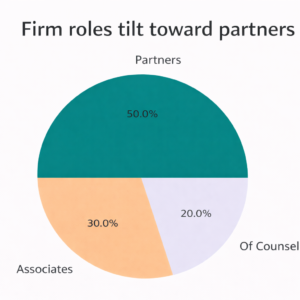
Within Colorado operations, partner composition varied widely. At some firms, more than half of their Colorado lawyers served as partners, while litigation-focused practices tended to have higher shares of associates. An analysis of firms that provided headcounts did not show a strong relationship between a firm’s overall size and the number of Colorado lawyers it maintains.
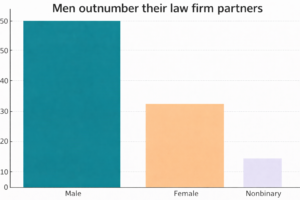
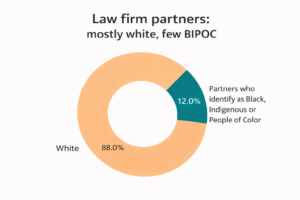
The data also shows disparities in gender and ethnic diversity at the partnership level across firm sizes and practice areas:
- Women made up 20% to 40% of Colorado partners at many firms, which mirrors national trends in female partner representation.
- People who identify as nonbinary comprised about 10% of partners, members or shareholders.
- Only about 12 percent identified as Black or indigenous or as a person of color, echoing national patterns at the partnership level.
Challenges Amid Growth
Beyond the numbers, firms described a year of successes, despite a bumpy start in certain practice areas.

Katie Reilly, president and partner with Wheeler Trigg O’Donnell LLP in Denver, noted, “We represent clients in high-stakes litigation throughout the country, and in Colorado, we’re seeing an increase in the complexity of litigation.” Specifically, she said, “Colorado is becoming a hotbed for class actions and multi-party complex commercial litigation and antitrust litigation, and our client work reflects this trend.”
Wheeler Trigg O’Donnell is representing a Power Four athletic conference in class-action litigation involving name, image and likeness, and partner Fred Yarger argued before the U.S. Supreme Court last fall in a case with implications for tort reform.
Deborah Bayles, Denver office managing partner at Stinson LLP and a member of the firm’s banking and financial services group, said 2025 unfolded in two phases. “The year started

off slower than we hoped with hesitation around rates and broader market uncertainty,” she said. “But we saw activity pick up as the year went on” as clients who had been waiting for clarity moved forward with financing and transactional work.
She saw client behavior shift as well. “Clients are engaging earlier, asking more questions and preparing for a range of scenarios,” she said.
Colorado’s mid-level office and retail sectors “remain comparatively healthy,” Bayles added. Litigation volumes stayed steady, too, particularly in commercial and employment matters.
Strategically, Stinson established a presence in California this year, which, Bayles said, “will help us better serve existing clients and attract new ones, including Colorado clients whose needs are national in scope.”
Other firms likewise reported significant growth in 2025.

Reed Smith LLP expanded into Denver, Atlanta and its third office in the Middle East. Denver office managing partner Jay Spader said, “The Denver office has hit the ground running, and integration into the Reed Smith platform has been successful beyond our expectations.”
Claire Wells Hanson, member-in-charge of Clark Hill’s Denver office, said 2025 “surpassed our expectations, with demand up in nearly every one of our core practice areas.”
One of the more unusual trends Hanson observed was the simultaneous strength of litigation and mergers and acquisitions (M&A). “Usually, litigation and M&A are inversely related; when one is up, the other is down,” she

said. “But in 2025, both were relatively busy.”
She also saw clients increase their spending and risk tolerance in litigation as the year progressed. Hanson said the firm saw a rise in clients opting to file affirmative claims to enforce their rights, rather than limiting their posture to defense.
Shawn Turner, executive partner of Holland & Knight’s Denver office, pointed to his firm’s similarly strong year. “We exceeded expectations in terms of demand across all of our core practice areas,” he said. “Clients remain focused on responsive, high-quality legal services for a fair value.”
Steven B. Epstein of Epstein Patierno LLP noticed shifts in client behavior not necessarily related to law. In his family law practice, tensions and impatience have heightened not only between clients but also in interactions among “all parties, counsel and the courts.” He said, “I’m perceiving heightened worries about economic uncertainty regarding the job market and interest rates, which manifest in decreased risk tolerance.”
Regulatory developments shaped the firm’s work this year, as changes to the statutory formula for child support will affect clients with children. At the same time, the federal government’s stance on immigration has created uncertainty, and legal residents have expressed fear of deportation and/or are avoiding police or judicial contact. Epstein said the

environment has, at times, allowed immigration concerns to be used as leverage in settlement negotiations.
Despite challenges, Epstein Patierno met its financial goals for the year and most of its strategic objectives. Epstein credited the firm’s results to an intentional, client-focused approach.
“Our goal is to continue to practice law with a focus on client needs in as cost effective [a] way as possible,” he said. “Doing this, if the past is a prologue to the future, will result in satisfied clients and confident, content lawyers and staff.”