

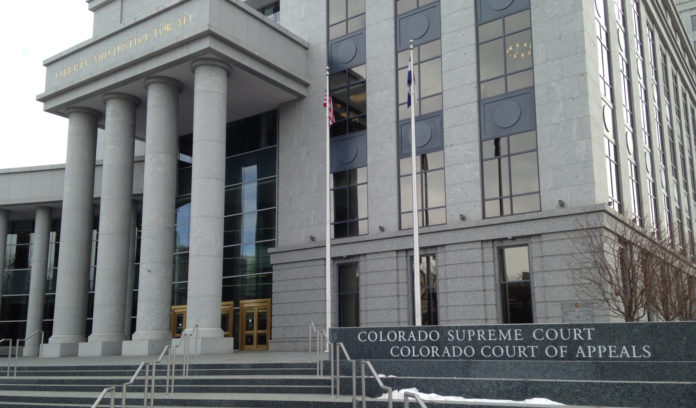
Editor’s Note: Law Week Colorado edits court opinion summaries for style and, when necessary, length.
People v. Melara
Nelson Melara appealed his conviction of two counts of sexual assault on a child (position of trust).
As a matter of first impression, a division of the Colorado Court of Appeals concluded that the trial court didn’t err by providing the jury with a definition of “beyond a reasonable doubt” that did not expressly inform the jury that it could base its verdict on the lack of evidence in the case. Although the trial court should have included the lack-of-evidence language, the omission didn’t lower the prosecution’s burden of proof and didn’t err given the facts of the case.
People v. Genrich
James Genrich was convicted of two counts of first-degree extreme indifference murder and multiple other felonies in connection with a series of pipe bombings from 1989 to 1991 in Grand Junction, Colorado. In 2016, nearly two decades after the Supreme Court denied certiorari on his direct appeal, Genrich filed a motion based on newly discovered evidence. He alleged that the science underlying expert toolmark evidence presented at his original trial, which had connected tools found in his one-room boarding house apartment to toolmarks on the bombs, was no longer endorsed by mainstream science.
Following a hearing ordered by a division of the Colorado Court of Appeals, the postconviction court determined that the expert testimony from the original trial was neutralized by the new evidence. It granted Genrich a new trial.
The prosecution appealed, contending that the postconviction court abused its discretion by determining that the new evidence was sufficiently material to warrant a new trial. Instead, prosecutors argued it was merely for impeachment and cumulative of the original trial evidence. Prosecutors also claimed that even if the new evidence was sufficiently material, there was ample remaining evidence upon which a jury could rely for a conviction.
The Court of Appeals concluded that the postconviction court acted within its discretion and affirmed.