

After months of voicing concerns about the current administration’s approach to medical research and health care, 15 governors — including Colorado Gov. Jared Polis — are taking the health of their constituents into their own hands this year.
The Governors Public Health Alliance, founded near the end of 2025, is based on previous compacts between western states and reflects Colorado’s commitment to making health care more affordable, equitable and innovative, according to a statement from Polis’ office.
The alliance aims to strengthen cross-state coordination on public health policy and emergency preparedness. Polis and Illinois Gov. J.B. Pritzker serve as co-chairs of the alliance.
“We have been laying the groundwork for this alliance for several months at the direction of multiple governors’ offices, knowing that the stakes for public health are higher than ever,” said Julia Spiegel, CEO of GovAct, a nonpartisan nonprofit initiative that supports coordinated governor action and helped launch the alliance.
“The need for this type of coordination has become especially apparent with the diminished capability at HHS and CDC, but this type of infrastructure would have always been helpful, and governors are eager to work together to protect public health,” she added. “When it comes to public health, the more coordination we can facilitate, the better. Especially given the changing landscape at the federal level in the U.S., having ways to communicate across borders is critical.”
This collaboration between states requires a solid legal framework.

Ellen E. Stewart, a partner in Spencer Fane’s Denver office, helps health care clients navigate legal issues and regulations. She noted that Colorado has long been a leader in interstate health care compacts, paving the way for the Governors Public Health Alliance.
“Colorado was the first state to enact a compact to permit emergency medical services personnel to provide services across state lines without needing to get a separate license in each state,” she explained.
Likewise, the state participates in compacts for nurses, physicians and physician assistants, which allows providers to respond to health care concerns in states with the greatest need. Compacts also are used to facilitate telehealth services among states. The American Medical Association has endorsed the interstate compact for physicians because it streamlines the licensure process and provides uniformity across state borders.
The success of these established compacts is the basis for the Governors Public Health Alliance. “The compacts were tested in the COVID-19 pandemic and appeared to work well to provide needed resources,” Stewart said. “Examples include healthcare providers traveling from states that were not experiencing a high number of cases to those states that needed additional assistance.”
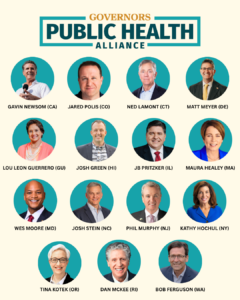
The Governors Public Health Alliance is guided by public health experts, GovAct’s bipartisan advisory board of former governors and senior federal officials. The U.S. territory of Guam has joined the alliance’s founding states: California, Colorado, Connecticut, Delaware, Hawaii, Illinois, Maryland, Massachusetts, New Jersey, New York, North Carolina, Oregon, Rhode Island and Washington.
“Participating states have already begun sharing best practices, participating in briefings with public health experts and coordinating on executive actions governors can take to strengthen public health protections, including standing orders or directives to preserve access to COVID-19 vaccines,” Spiegel said.
One of the first acts of the alliance was in response to shifting messaging from the federal government on vaccines. During the alliance’s incubation process last summer, “GovAct developed and shared a back-to-school vaccine toolkit to help governors navigate the shifting federal landscape on vaccine access,” Spiegel recalled. “The toolkit explained changes in federal vaccine guidance for routine and annual vaccines and shared model actions governors could take —and dozens of states now have.”
As the current administration’s approach to health care and science makes headlines, the alliance remains in discussion with governors’ offices and state health department officials nationwide. Spiegel said, “We welcome further conversations with governors interested in working together to protect public health and look forward to continuing to grow the work and the ranks of this alliance.”
In 2026, the alliance hopes to strengthen the public health infrastructure in their states by addressing gaps in preparedness, standardizing guidance on public health issues and serving as a liaison to the global health community.