


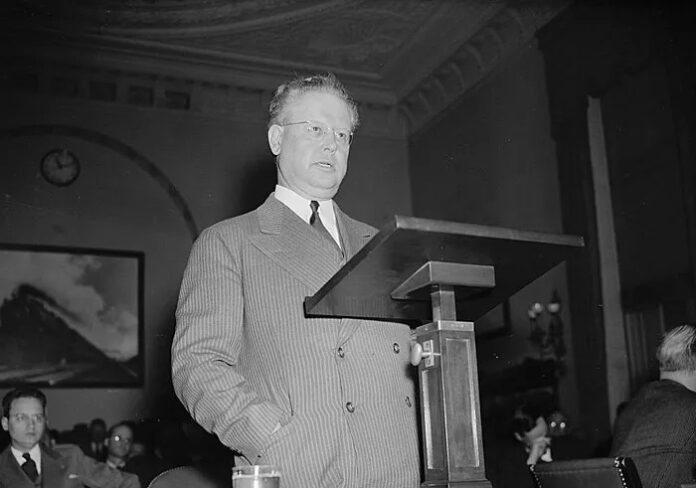
As the glow of Independence Day fireworks fades and the nation turns toward a polarizing midterm election season, many in the Colorado legal community have chosen to celebrate Gov. Ralph Carr, a state leader who understood that defending constitutional principles is most critical when it’s costly.
For Carr, the practice of law and the administration of government were inseparable from the protection of individual rights. Serving as Colorado’s 29th governor from 1939 to 1943, he is best known for defending civil liberties during World War II, when fear and prejudice threatened to overwhelm constitutional safeguards.
After anti-Japanese sentiment swept the country following the attack on Pearl Harbor, Carr insisted that “Japanese Americans were Americans, and Americans ought to be treated like Americans,” said Adam Schrager, teaching faculty at the University of Wisconsin-Madison and author of “The Principled Politician: The Ralph Carr Story.”
Carr, a Republican, was the only western governor to oppose federal orders authorizing the relocation and internment of Japanese Americans, contending the constitutional rights of any citizen could not be discarded in wartime. He publicly welcomed displaced Japanese Americans to Colorado and defended them against hostile crowds.
“Carr would say, ‘Principles are as true as truth and will last as long as God’s creation,’” Schrager said.
A Career Rooted in Community
Born to a family of Scots-Irish miners in Rosita, Colo., Carr graduated from the University of Colorado Law School in 1912. He built a legal practice in southern Colorado focused on irrigation and interstate water law and taught himself Spanish to better communicate with local residents. Friends and colleagues recalled that he treated farm workers and laborers with the same attention he gave business leaders and politicians. After he was elected governor, Carr hired George Robinson, who had written to him during the campaign to express his support, as the first Black employee to work behind the front desk of the governor’s office. Robinson later became a close aide and trusted friend.
Carr’s legal career included serving as assistant Colorado attorney general and later as U.S. attorney for the District of Colorado. Both roles reinforced his belief that the Constitution and the rule of law were not conveniences to be set aside when public opinion shifted.
Endangering the Liberties of All
As Carr faced questions on how to respond to the movement of Japanese Americans into Colorado, he repeatedly warned that abandoning constitutional protections for one group endangered the liberties of all Americans.
According to Carr, said Schrager, “If you’re going to deprive someone of their constitutional rights without evidence, without a trial, what’s to say that six months from now you and I will not find ourselves subject to that same whim of government?” Schrager added, summarizing Carr, “If the principles of the Constitution can be taken away for any man, then they will not be there for any man.”
Although Carr did not publicly object to the removal of Japanese non-citizens to internment camps, he did say often that every person should be treated with dignity, which also inflamed his constituents.
Throughout the war, Carr was barraged with hate mail and criticized relentlessly in newspapers and on the radio. Yet Schrager found no indication that the governor ever reconsidered his position.
“The thing I’ve always found most striking in doing the research was just how lonely it must have been,” Schrager said. “I found zero — zero — evidence that he ever wavered, which was even more striking.”
Carr’s treatment of Japanese Americans came at a steep political cost. In 1942, he lost the U.S. Senate race to the incumbent Democrat Edwin Johnson, who advocated using the Colorado National Guard to prevent detainees from entering Colorado. Johnson claimed that Carr was more interested in exploiting the labor of the detainees than in protecting their rights. Carr’s loss effectively ended what was once a rising national political career.
Returning to private practice in 1943, Carr continued representing those who lacked political power, even writing to Hollywood figures to urge them to stop perpetuating harmful stereotypes of Native Americans.
Carr died in 1950 shortly after securing the Republican nomination for a gubernatorial comeback.
A Legal Legacy
Decades later, Carr’s willingness to place constitutional principles above political calculation solidifies his reputation within Colorado’s legal community.
The Ralph L. Carr Colorado Judicial Center, home to the Colorado Supreme Court and Colorado Court of Appeals since 2013, stands in downtown Denver as a reminder of the values Carr championed.
When Chief Justice Monica Márquez first joined the Colorado Supreme Court, she was appointed to a committee overseeing the learning center for the judicial building then under construction. It gave her a front-row seat to the process of honoring a leader who has come to represent the highest ideals of law in Colorado.
“I find him an inspiration because of his work in the San Luis Valley, which is where my family roots come from,” Márquez said. “In a very politically fraught time, he was willing to take a very politically unpopular stand. That, to me, is true courage.”
During the U.S. bicentennial in 1976, a statue was dedicated to Carr in Sakura Square in Denver. Part of the inscription reads, “Those who benefited from Governor Carr’s humanity have built this monument in grateful memory of his unflinching Americanism and as a lasting reminder that the precious democratic ideals he espoused must forever be defended against prejudice and neglect.”
Schrager said Carr “absolutely loved being a lawyer.” Whether he was presiding over a case in a small town in southern Colorado, serving as governor or defending his values during his final campaign for governor, he viewed the profession as a calling to preserve the framework that protects individual liberty.
“We want to believe that if we were in a similar position, we would act similarly,” Schrager said. “Here’s an example of someone who did it, who lived according to his principles.”
As for whether a figure like Carr could emerge today, Schrager said simply, “I hope so. And if not, what are we doing here?”