


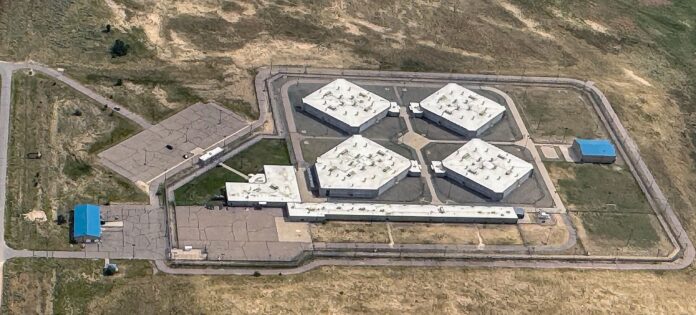
A lawsuit challenging the Town of Hudson’s handling of a proposed 1,188-bed immigration detention center is taking aim at what plaintiffs characterize as contradictory positions by town officials about their authority to regulate the facility.
Hudson has repeatedly maintained that it lacks authority to approve or deny the proposed use of the former Hudson Correctional Facility as an immigration detention center. But plaintiffs say documents obtained during the litigation show town officials did consider whether the proposed facility complies with Hudson’s land-use code and determined that it could operate without going through the public approval process the plaintiffs say is required.
The dispute is at the center of an amended lawsuit filed in Weld County District Court by Together Colorado, three residents of Hudson and one resident of Weld County. The plaintiffs are represented by Denver-based nonprofit public interest law firm Towards Justice.
At issue is whether Hudson must apply its local zoning regulations to a privately owned facility that would be operated by The GEO Group under a contract with U.S. Immigration and Customs Enforcement.
David Seligman, executive director of Towards Justice and an attorney for the plaintiffs, said the town’s obligation is straightforward.
“The facility is just flatly in violation of the town of Hudson zoning laws,” he said. “If GEO really wants to operate it as an immigration detention center, it’s got to go through the same process every other institution would have to go through.”
The former correctional facility is located in an I-3 industrial zoning district. The amended complaint alleges that Hudson’s Land Development Code does not list either an “immigration detention facility” or “correctional facility” as a permitted use in that district and generally prohibits unlisted uses.
The facility previously operated as a private prison for the Alaska Department of Corrections from 2009 to 2013. At that time, according to the complaint, Hudson issued a conditional-use permit for an adult medium-security correctional facility, and Hudson voters approved the permit. The permit provided that any proposed change in the facility’s specified use would have to return to Hudson for a revision to the conditional use.
The plaintiffs contend that more than 12 years of vacancy extinguished the prior nonconforming-use status and that the proposed immigration detention operation constitutes a new or materially different use requiring approval under the current code.
The town said in a community update in July that it does not have authority to approve or deny federal use of the facility, while acknowledging it would be responsible for local roads, water and wastewater, emergency response, fire and EMS services and other infrastructure potentially affected by the facility, according to the amended complaint. The plaintiffs argue that the town’s own recognition of those responsibilities undercuts its position that it has no land-use authority.
A town planning document obtained by the plaintiffs takes a different approach, according to Seligman. The document concludes that, under a reading of the town code, the facility can be treated as a government building or safety-service facility and therefore permitted by right.
Seligman said that interpretation is inconsistent with both the code and the nature of the proposed operation. GEO is a private, for-profit company that would operate the facility under a federal contract. The property itself is owned by a subsidiary of Highlands REIT, according to the complaint. U.S. Immigration and Customs Enforcement awarded GEO a five-year support-services contract in July for the facility.
To follow the law, the Town of Hudson “would have to either prohibit the operation of the facility as an immigration detention center or, at the very least, give the residents of Hudson, the Town Council, an opportunity to weigh in and decide whether to grant the conditional use permit,” Seligman said.
The plaintiffs have asked the court to require Hudson to enforce its Land Development Code, set aside the town’s determination that it lacks authority over the facility and declare that the proposed immigration detention use is subject to local zoning and permitting requirements.
The case presents a question about the intersection of federal immigration authority and local land-use regulation. The plaintiffs argue that federal law does not preempt Hudson’s zoning authority because the facility is privately owned and operated rather than federally owned or directly operated.
Seligman said the issue could extend beyond Hudson, as other Colorado communities confront proposals for immigration detention facilities or temporary detention sites. “Local zoning laws are not preempted just because we’re talking about immigration detention,” he said.
The lawsuit is separate from a federal case filed Sept. 29 by Colorado Attorney General Phil Weiser challenging the federal government’s failure to conduct environmental review before proceeding with the Hudson facility. That lawsuit alleges violations of federal environmental and immigration laws and seeks to halt work on the facility pending the required review.
Seligman said the two cases involve different legal theories but reflect a common question about whether GEO and ICE must comply with laws that otherwise apply to the project.
“These reflect a pattern of thinking, but GEO and ICE are just not above the law,” he said.
The Hudson plaintiffs’ case remains in its early stages. The town previously moved to dismiss the lawsuit, and the plaintiffs filed an amended complaint in September. Seligman said the amended pleading mooted the earlier motion to dismiss and that the plaintiffs are prepared to respond if Hudson files another motion.
The plaintiffs are asking the court for expedited review because GEO has indicated it intends to begin operations within months.