



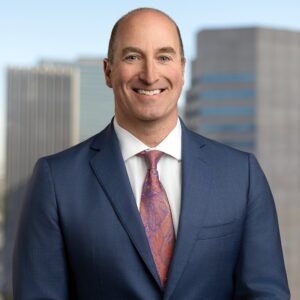
Thanks to a legal career in military courtrooms, corporations and private practice, Michael Freimann brings an especially nuanced perspective to the attorney-client relationship.
Freimann, who recently became a partner in Taft’s Denver office, spent 24 years in the Air Force JAG Corps before moving into private practice, then in-house counsel and eventually back to private practice. Along the way, he said, each role taught him something different about how lawyers can best serve their clients.
Freimann’s early work in the JAG Corps included criminal prosecution and defense. “I got incredible courtroom experience right out of the gate,” he said.
The military also taught him to stay calm under pressure and communicate complicated issues to senior leaders — skills that proved useful when he moved from the courtroom to the corporate world.
Freimann’s move in-house in 2008 was motivated partly by curiosity: He wanted to understand how businesses operated and what made them successful.
The experience changed the way he viewed the lawyer’s role. “The legal answer is not always the solution to the problem at that time,” he said.
A lawyer, he learned, must understand what the client “is actually trying to accomplish and help find a way to get there” while managing legal risk.
“You need to be comfortable struggling back and forth between wearing your legal hat and your business hat,” he said.
His newly gained business perspective informed his return to private practice. He said he was drawn back in part by an entrepreneurial challenge: building his own practice, which has grown each year with the support of loyal clients.
Freimann said he continues to enjoy his work in employment law because of its human element.
“It’s not always black and white,” he said. “You have to be comfortable living in the gray.”
Employment lawyers frequently work with clients when emotions and frustration are running high. Freimann said he enjoys bringing calm and practicality to those situations, sometimes with humor. He also appreciates the variety of the work, from discrimination claims to noncompete issues, wage-and-hour disputes and leave matters.
And the field keeps changing.
Over the past two decades, Freimann said, employees have gained more workplace protections, requiring employers to keep up with changes in the law rather than relying on longstanding practices.
Technology has altered the nature of disputes, too. A workplace conflict that might previously have come down to “he said, she said” could now be accompanied by a video recorded on a phone, a social media post or other electronic evidence.
“I always tell my clients that the ‘e’ in email stands for evidence,” he said.
For employers, Freimann said, one of the biggest mistakes he sees is a failure to communicate. When employers explain their decisions professionally and make employees feel heard and respected, disputes are more likely to end there.
An emphasis on communication reflects another lesson Freimann took from his time in-house: Lawyers are providing a service, and understanding the client’s needs is essential.
It is also part of what drew him to Taft, where he joined the Denver office as a partner in June. The firm’s national and Denver growth, along with its resources, appealed to his desire to serve clients fully.
He saw the value of that breadth almost immediately: When a client reached out to him one Friday afternoon with an issue requiring specialized knowledge, Freimann was able to connect the client with a partner who had the necessary niche expertise, and the three were on a call together Saturday morning.
“To me, that’s great customer service,” he said. “That’s what I was looking for in a firm.”
At Taft, Freimann hopes to continue growing the firm’s employment practice and make it a go-to team in Colorado and beyond.
His military experience still influences how he approaches his work. Freimann conducts his own version of an after-action review after a matter concludes, considering what went well, what could have gone differently and whether a different approach might have produced a better outcome.
He also remains involved with military and veterans’ causes. He has worked with the USO and veteran organizations and has helped veterans with legal issues, including housing disputes and efforts to upgrade discharge characterizations.
“I love helping people solve their problems,” he said.
He enjoys the people around him, too — colleagues, clients and the younger lawyers he mentors — and the opportunity to keep learning. When he’s not doing legal work, he spends time with his wife and sons, watching them play sports and sometimes joining in.