


How AI and Changing Search Behavior are Reshaping Online Client Discovery
Many law firms have asked some version of this question recently:
Why does the new case flow feel less predictable even when rankings and website traffic still look relatively stable?
The answer has less to do with rankings themselves and more to do with the new way people search for and evaluate law firms online.
For years, the process was fairly straightforward. Someone searched Google, visited a few law firm websites and decided who to call. Increasingly, that process is changing. People are asking AI tools legal questions before contacting attorneys. They are comparing reviews before visiting websites, validating firms through brand searches and forming opinions through Google Maps listings and AI-generated summaries before a law firm ever receives a call or form submission.
In many cases, the website is no longer the first significant interaction a potential client has with a firm.
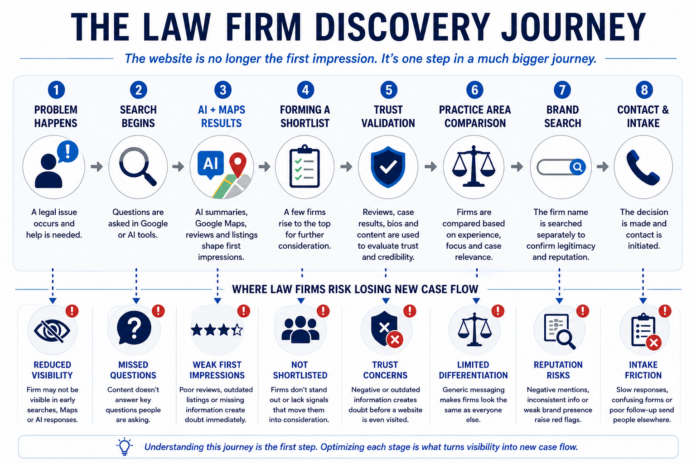
The Law Firm Discovery Journey
One way to understand this shift is through what can be called the “Law Firm Discovery Journey”: problem happens → search begins → maps and AI results → shortlist formation → trust validation → practice area comparison → brand search → contact and intake.
At each stage, people are making small decisions about trust, relevance and credibility.
The process often starts immediately after a legal issue occurs. Someone involved in a car accident, employment dispute, or family law matter may begin searching under stress and with very little knowledge of the legal process. With AI, those searches are becoming more conversational and informational.
Instead of searching only for phrases like “Denver personal injury lawyer,” users may ask broader questions such as:
● “Do I need a lawyer after a truck accident?”
● “How long do I have to file a claim?”
● “What should I do after a workplace injury?”
A person who once searched “Denver truck accident lawyer” may now begin by asking an AI assistant whether they even have a case, how long claims usually take, or whether hiring an attorney is necessary.
Many of those questions are now being answered, at least partially, before someone ever reaches a law firm website.
A recent LexisNexis consumer survey found that among consumers familiar with generative AI tools, 48% had already used AI for legal advice or assistance with a legal question.
Google’s AI Overviews, ChatGPT, Gemini and other AI-assisted tools can summarize information directly within search experiences. Research from the Pew Research Center recently found that users presented with AI-generated summaries were less likely to click traditional search results than users who did not encounter AI summaries.
That matters more than many firms realize.
Maps, AI Summaries and First Impressions
Before reaching a website, people may first encounter:
● Google Maps listings
● AI-generated summaries
● Review platforms
● Directory listings
● Featured search snippets
Those touchpoints often shape early impressions long before a law firm receives a call.
For many firms, the first impression is no longer the website itself. It is the AI summary, Maps listing, or review profile that appears before the click.
A firm can still rank well and technically “show up,” while losing attention during the comparison stage. One listing may appear more active, more specialized, or simply more trustworthy than another, even when both firms appear in similar positions within search results.
Many people now perform separate brand searches after first discovering a firm. Someone may encounter an attorney through Maps, a review platform, or an AI-generated result, then search the firm name independently before deciding whether to call.
That second search acts as a credibility check.
Some people may compare reviews and attorney bios. Others may look for verdicts, settlements, or media coverage before ever contacting the firm. By the time someone reaches a law firm website, they may already have formed opinions about trust, experience and relevance.
Shortlists, Practice Area Pages and Trust Validation
Another important shift is how quickly people narrow their options.
Many users may only seriously compare a handful of firms before deciding who to contact. Visibility alone no longer guarantees meaningful consideration.
Practice area pages still matter, but people now evaluate firms based on clarity and specificity rather than rankings alone. Generic or outdated content can make firms appear interchangeable, especially when someone is comparing several firms quickly.
A person researching a trucking accident case, for example, may specifically look for references to catastrophic injuries, commercial vehicle litigation, or trial experience instead of broad personal injury language.
Search behavior is becoming more intent-driven and more evaluative. People want confirmation that a firm regularly handles matters similar to their own before making contact.
Trust validation also now extends well beyond the law firm website itself. In some cases, a person may spend more time comparing reviews, attorney bios and AI-generated summaries before making contact.
The Contact Stage Still Matters
Even after someone decides to contact a firm, the discovery journey is not necessarily over.
Slow callbacks, confusing forms, or unclear intake processes can still interrupt conversion into a consultation or retained case. A firm may successfully build trust throughout the earlier discovery stages only to lose momentum during intake.
This is one of the issues law firms can sometimes misunderstand as it relates to new case flow because it is not shown in traditional reporting.
Conclusion
Search visibility still matters, but the path between visibility and retained cases is becoming more layered than it was several years ago.
People ask AI tools questions before contacting attorneys. They compare firms through Maps listings, reviews, AI-generated summaries and brand searches before deciding who to trust. In many cases, the website is no longer the first impression. It is simply one step within a broader digital evaluation process.
As AI-assisted search and online discovery continue to evolve, law firms may benefit from examining not only how people find them, but also how those people form trust and make decisions before contact ever occurs.

Calvin Carter is the founder of RankCraftr, an AI-driven SEO and visibility analysis platform focused on law firms. He works with firms to better understand how online search behavior, AI-assisted discovery and digital trust signals influence new case acquisition.
Contact: [email protected]