



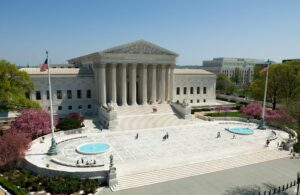
The U.S. Supreme Court’s 2025–26 term reshaped constitutional boundaries governing executive authority while expanding First Amendment protections.
Across decisions involving presidential power, campaign finance, professional speech, LGBTQ+ rights, voting rights and birthright citizenship, the Roberts Court revisited longstanding precedents and constitutional doctrines, reflecting a willingness to reexamine questions many considered settled.

“It’s tempting to view each case in isolation,” said Brian Underwood, a litigator on Bryan Cave Leighton Paisner’s Media and First Amendment Team. “But when you look across the First Amendment docket, the Court continues to approach government restrictions on speech with deep skepticism, even while other areas of constitutional law are evolving.”
Revisiting Precedent
During the Byron R. White Center’s annual U.S. Supreme Court Review at the University of Colorado Law School, professors and practitioners highlighted a theme that cut across much of the term: the Court’s growing willingness to revisit earlier decisions.

Doug Spencer, professor of law at the University of Colorado, pointed to election law cases revisiting longstanding interpretations of the Voting Rights Act, partisan gerrymandering and campaign finance. Discussing Louisiana v. Callais, he highlighted tensions between the Court’s recent opinions and earlier precedent interpreting the Voting Rights Act’s results test.
Underwood identified a similar trend in campaign finance jurisprudence.
Campaign finance provided another example of an expansive understanding of free speech. In National Republican Senatorial Committee v. Federal Election Commission, which overruled Federal Election Commission v. Colorado Republican Federal Campaign Committee (Colorado II), the Court struck down limits on coordinated expenditures between political parties and candidates.
“The decision to revisit Colorado II is significant,” Underwood said. “When the Court starts revisiting precedents, recent or old, in large part because it simply believes the earlier decision was wrong, that bedrock becomes less stable.”
He said the Court explicitly referenced lower court judges who had questioned Colorado II, suggesting the justices are paying attention to criticism emerging from the federal judiciary.

Deep Gulasekaram, professor of law and director of the Byron White Center, said the Court’s birthright citizenship decision is another example of the justices revisiting foundational constitutional questions. He argued that both the Fourteenth Amendment and subsequent federal statutes have long settled the scope of birthright citizenship, making the litigation notable less for its outcome than, again, the Court’s willingness to revisit what many considered established doctrine.
Beyond constitutional law, in Monsanto v. Durnell, the Court held that federal law preempts state-law failure-to-warn claims based on pesticide labels approved by the U.S. Environmental Protection Agency. The ruling eliminated one of the principal legal theories underlying thousands of Roundup lawsuits while leaving other claims intact.

Brent Wisner, managing partner of Wisner Baum, whose firm represents approximately 1,000 plaintiffs in litigation against Monsanto, said the decision illustrates how the Court can significantly reshape litigation without foreclosing it altogether.
“All of the litigation is affected because they can no longer pursue failure-to-warn claims based on EPA-approved pesticide labels,” he said. Plaintiffs may still pursue claims based on design defects, negligence or failures to warn outside the product label, such as through advertising.
Redrawing the Separation of Powers
Panelists at the University of Colorado Law School event identified another recurring theme this term: The Court repeatedly reconsidered which branch of government holds constitutional authority.
Aaron Van Oort, a partner at Faegre Drinker Biddle & Reath, pointed to a pair of administrative law decisions addressing presidential removal authority.
In one, the Court held that officials exercising executive power generally must remain accountable to the president through at-will removal. In another, it carved out an exception for the Federal Reserve, insulating monetary policy from political influence.
Van Oort described the contrast as striking, with one opinion grounded in constitutional theory and democratic accountability while the other appeared driven by practical consequences.

University Distinguished Professor and Rothgerber Chair in Constitutional Law at the University of Colorado Law School Helen Norton observed a similar dynamic in the Court’s decision on presidential tariff authority.
Rather than resolving sweeping constitutional questions about executive emergency powers, the Court interpreted the governing statute narrowly, concluding Congress had not clearly delegated broad taxing authority to the president.
An Expansion of First Amendment Doctrine
Across multiple cases, the justices treated speech protections with rigorous constitutional scrutiny.
“Whatever ideological divide people tend to assume exists among the Supreme Court justices, that divide has a tendency to collapse on speech issues,” Underwood said. “There seems to be a consistent recognition that the First Amendment is special — that our right to free speech is not, and should not be, a political issue.”
In Chiles v. Salazar, the Court held that Colorado’s prohibition on conversion therapy for minors, as applied to licensed therapists providing talk therapy, must satisfy strict First Amendment scrutiny.

Scott Skinner-Thompson, professor of law at the University of Colorado, emphasized that the Court did not invalidate Colorado’s law. Instead, it concluded that regulations targeting speech by licensed professionals require heightened constitutional review before lower courts determine whether they ultimately survive.
Looking Ahead
For Colorado practitioners, the practical implications extend beyond a single opinion. Whether advising clients on constitutional challenges, regulatory disputes or litigation strategy, attorneys are increasingly practicing in a legal environment where assumptions about executive power, speech protections and even established precedent may no longer hold.
Underwood said attorneys should consider First Amendment arguments whenever statutes or regulations affect how clients communicate, even in areas traditionally viewed as health, safety or professional regulation. “First Amendment concerns should be a routine part of legal issue spotting,” he said.
Taken together, the term was less about any single headline-making decision than about a broader reexamination of constitutional structure. Across multiple areas of the law, the Court asked who exercises governmental power, how far that power extends and when constitutional protections limit it. For Colorado lawyers, that means arguments once viewed as unlikely — and precedents once thought settled — may deserve a second look.