



In an era marked by escalating rhetoric against court rulings, threats to the physical safety of judges and skepticism over election integrity, two veteran public servants are on a mission to restore public trust in the rule of law.
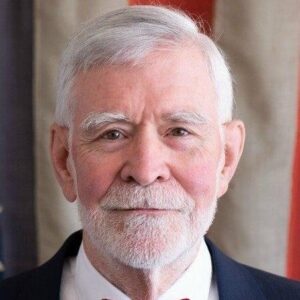
In honor of Constitution Day this month, former U.S Rep. David Skaggs of Colorado and retired Tenth Circuit Chief Judge Deanell Reece Tacha spoke about their ongoing work with Keep Our Republic, an “adamantly nonpartisan” civic initiative, Tacha said, formed in the wake of the 2020 election and the attack on the Capitol on Jan. 6, 2021. Drawing its mandate from Benjamin Franklin’s famous quip, “A republic, if you can keep it,” Keep Our Republic aims to “safeguard the pillars of American democracy” as a network of volunteers and staff from different states and political parties, including retired jurists through its Article III Coalition.
For Tacha, who spent 25 years on the federal appellate bench before serving as dean of Pepperdine University School of Law, stepping into the public arena is an unusual but “necessary step” in light of our current moment, she said, adding that acting federal judges are structurally barred from mounting a public defense of their work.
Of the three branches of government, “the courts are the easiest ones to attack because we can’t attack back,” Tacha said. “All of us have been around about a lifetime watching judges do their work day by day by day, working very hard in courthouses around the country. In order for the rule of law to survive, it requires the public trust.”
Over the coming weeks and with the November election in view, Tacha is speaking at town halls and civic forums, presenting Government 101: what the rule of law means, how separation of powers operates and how judges work to apply facts to law.
Skaggs, who represented Colorado’s 2nd Congressional District for 12 years and is executive board chair of Keep Our Republic, emphasized that the Article III Coalition serves as a dispassionate resource for a media landscape often ill-equipped to interpret attacks on judicial norms.
Considering the Size of the Supreme Court

In partisan times, some wonder if the temperature would be turned down, or turned up, if the number of justices on the U.S. Supreme Court was altered.
While Skaggs and Tacha noted that the Constitution assigns Congress sweeping, plenary authority to dictate the size and structure of the federal bench — a power exercised repeatedly throughout the 19th and early 20th centuries — constitutional authority does not translate into political feasibility or institutional prudence.
Skaggs said the idea of expanding the bench to 13 justices to align with the nation’s 13 federal appellate circuits may be structurally logical, yet the 60-vote Senate filibuster makes statutory expansion practically impossible.
More critically, Tacha cautioned that any attempt to alter the court’s size in a hyperpolarized climate could be devastating to public faith in the institution. “No matter who is in power, it will look political, and it would strike at the heart of the independence of the judiciary, certainly the public perception,” she said.
Were Congress to pass such a measure, Tacha and Skaggs concurred that the high court would almost certainly decline to review it, treating the bench size as a nonjusticiable political question belonging to the legislative branch.
When addressing other reform efforts, such as statutory ethics codes and term limits, the legal analysis is more nuanced. Skaggs suggested the Constitution’s “good behavior clause” offers Congress an implicit foundation to legislate ethics rules for the nation’s highest court. Tacha said faithful judges would not resist reasonable financial and conflict reporting standards so long as judicial decision-making remains uncompromised.
Term limits, however, drew caution from Tacha. Reflecting on her appointment to a newly created seat on the Tenth Circuit, she identified life tenure as an essential shield protecting jurists from external pressure.
“The most liberating day of my life was the day I was confirmed, and I only had to serve the law and the facts and the litigants before me,” she said. “I wasn’t beholden to any political structure or any person or any interest. If you know you’re going to be done at 18 years, in my view, that undercuts a bit of what the founders really placed their trust in.”
Lawyers and Elections
Beyond structural debates, Tacha and Skaggs stressed that preparation is underway to uphold the legitimacy of the upcoming elections. Legal teams across the country are reviewing statutory mechanisms and historic common-law remedies, including writs of mandamus, to ensure election officials carry out mandatory, ministerial certification duties if administrative disruptions occur.
Tacha believes members of the bar can act as “civic translators” in their communities to mitigate cynicism about the rule of law. “Lawyers are trained to both articulate and understand both sides of an issue,” she said. “Instead of this cacophony of partial truths, untruths or just worries, lawyers have a big role to play in articulating the facts and making sure that the voters and the public and young people understand what is at stake. The first reason people lose their trust in government is when they hear this wild commotion and say, ‘Why buy in?’ Lawyers have a very subtle, but extremely important role.”