


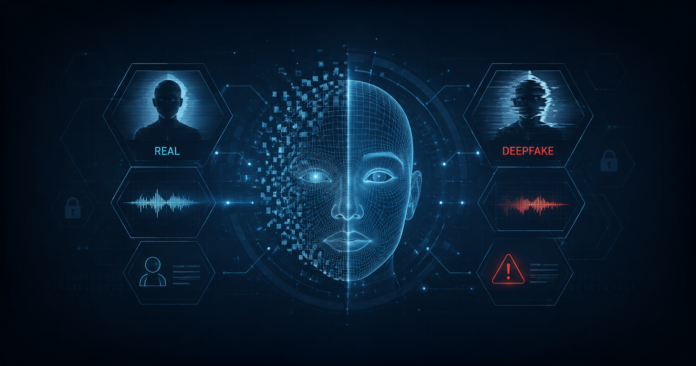
By any measure, visual evidence has carried unusual weight in the courtroom, with photographs treated as near-objective truth until editing tools eroded image certainty.

Then, “video evidence was golden,” said Ken Griggs, an Emmy Award-winning technologist and founder of Julia.social and not.bot.
“Now video can be edited the same way images can,” he said. “Very soon, if not already, it will be completely indistinguishable from real.”
Griggs, who has spent more than two decades working in blockchain and cryptography, aims to develop a solution to one of the most befuddling problems at the intersection of law, artificial intelligence and trust: how courts, and society at large, should handle a world in which seeing ought not to correspond with believing.
The Problem of Deepfakes in the Courtroom
Deepfakes are AI-generated or AI-altered media (images, audio or video) that depict events falsely.
“The threat is huge,” Griggs said. “We only know about the fake content that gets detected. The ones that pass as real? Those don’t show up in the data.”
In other words, courts can only evaluate the media they suspect as inauthentic, not what deceives.
The Detection Problem Worsens
To identify manipulated media, digital forensics experts look for inconsistencies, such as objects that disappear between frames, lighting anomalies or pixel-level irregularities.
Yet according to Griggs, these methods are on borrowed time. “AI-generated images only really emerged about five years ago,” he explained. “Within that timeframe, we’re going to go from ‘very good’ to ‘completely indistinguishable.’”
As with most technological innovations, the tools used to authenticate digital evidence are improving more slowly than the tools used to fabricate it.
A Legal System Built for a Different Era?
Legal rules around authentication have evolved in response to analog photographs and, more recently, basic digital editing — not synthetic media generated by machine learning models, noted Sandra Ristovska, founding director of the Visual Evidence Lab and an associate professor of media studies at the University of Colorado Boulder.
Griggs believes the legal system is “not at all ready for AI.” At minimum, he argued, “courts should ask these threshold questions” for digital evidence:
- What is its provenance?
- How was it created?
- Has it been altered, and if so, how?
“I would propose that if it’s not verifiable, it should not be admissible,” he said.
In the meantime, Griggs suggested that courts may need to rethink conceptual as well as technical standards. “We could treat digital media like speech,” he said. “We require people to tell the truth. Treat images and video the same way, as something a person is responsible for unless proven otherwise.”
Industry Efforts: Provenance and Its Limits
Various efforts to address digital manipulation are underway.
Probabilistic analysis involves evaluating how difficult it would have been to create a given piece of media, rather than trying to definitively prove whether it is real.
“A new form of digital forensics might be assessing the level of difficulty,” Griggs said. “Not whether it was possible — because now, almost anything is possible.”
Another response to verifying images is C2PA, an initiative from Adobe attempting to track the history of digital media.
C2PA-enabled tools attach metadata to images and videos. As the tools verify origins and document edits, they create a transparent chain of custody for digital content, though the image must stay in the C2PA ecosystem for the chain to work.
This leaves challenges for widespread adoption, especially for everyday users capturing content on personal devices.
Griggs’ answer is to verify not media content but the humans behind it. In his platform, not.bot, users attach a cryptographic signature to digital media. The signature is tied to a verified human identity, derived from a secure source like a passport. “The only way we’re going to establish authenticity online is by signing content,” he said.
The system embeds a QR code into each piece of digital content. When scanned, the code reveals the verifiable details from the content’s cryptographic signature: who created the content, when it was created and a link to the original, unaltered version.
To protect privacy, personal data is encrypted and held in escrow, accessible only under specific legal conditions.
Again, the challenge is widespread adoption.
A Trust Reset
Even if superior tools emerge, whether through initiatives like C2PA or identity-based systems like not.bot, the legal system and the public must adjust expectations around video. “We’re going to have to relearn what to trust,” Griggs said. “Sooner rather than later.”